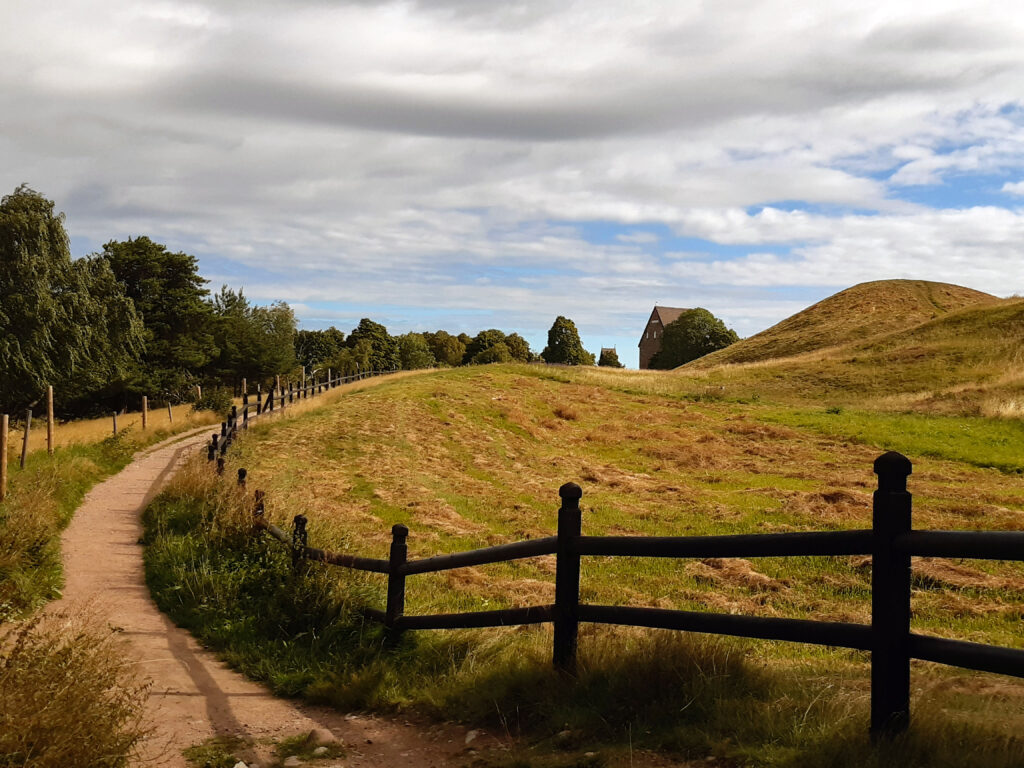
In 1070, the German monk Adam of Bremen wrote a chronicle known as the History of the Archbishops of Hamburg-Bremen. At the time, this archbishopric claimed missionary rights over the Scandinavian countries, so it was only natural that Adam should take great interest in the peoples and habits of these lands to the north. One of his most vivid descriptions is of a famous temple at Uppsala, “entirely decked out in gold”. Here, the people worshipped statues of the gods Thor, Odin and Freyr. In a nearby sacred grove, they would hang sacrifices from trees, including the bodies of dogs, horses and men. So dense was the place with rotting bodies that the air itself was putrid, but to the gods, this was pleasing.[1] He also mentions mountains, by which he is probably referring to the three massive burial mounds situated there. According to legend, this is where the three aforementioned gods lie buried.
Uppsala lies about an hour north of Sweden’s capital Stockholm. It is an atmospheric university town, known as the home of the pioneering biologist Carl von Linné. The place Adam described is now referred to as Gamla Uppsala (Old Uppsala) – a sleepy suburban village just outside the city centre. The old ritual site is today a tourist attraction, its burial mounds looking like natural elevations in the otherwise flat landscape. Where there was once a pagan temple, now lies a church.
Adam wrote at the tail end of what we call the Viking Age, by which time Christianisation was already well underway in Scandinavia: Denmark and Norway had already largely accepted the new faith, while paganism still survived in parts of Sweden, such as Uppsala. The burial mounds he mentions, though inextricably associated with the Vikings, were probably built for kings from the earlier, semi-legendary Yngling dynasty. This period is referred to in Sweden as the Vendel Period (from a rich archaeological site near Uppsala), in Norway as the Merovingian Period (after the contemporary Frankish dynasty), and in Denmark more prosaically as the Late Germanic Iron Age.
The term “Viking Age” itself is a strange one. Probably derived from vík, the narrow bays or fjords from which Scandinavian raiders supposedly poured out into the world, “Viking” came to denote this form of piracy. It is therefore an historical period named not after an empire or a technology, but after an activity – an activity, that is, in which only a small minority of its population ever took part. Since the following will primarily be concerned with raids and expansion, however, the term may be quite appropriate.
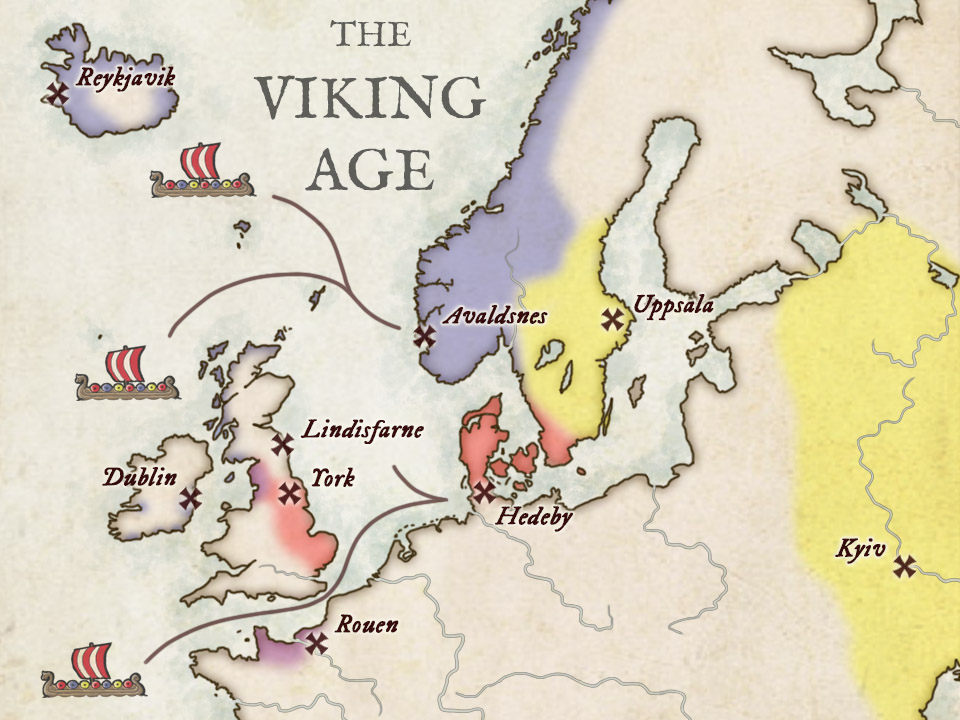
The Viking Age is the period of Scandinavian history roughly between 800 and 1050. It is convenient to bookend it by the first recorded Viking raid, on Lindisfarne in 793, and the Norwegian king Harald Hardrada’s attempt to invade England quashed at the Battle of Stamford Bridge in 1066. In this long 250-year period, the previously obscure Scandinavians had an outsized impact on European – and indeed world – history, within exploration, trade and state formation. It is worth giving a brief summary here of what was in fact achieved.
Perhaps the greatest testament to the seafaring skills of the Vikings was their discovery, in quick succession, of Iceland, Greenland and the New World during the 9th and 10th centuries. Unlike their other ventures, these were not made for plunder or trade, but for landnám, or settlement. The lands were uninhabited, or inhabited by non-agricultural peoples. It was therefore critical that these colonies should be viable for farming, while still in communication with Europe for import of other goods. While the Icelandic settlement remains till this day, the American – called Vinland by the Norse settlers – was abandoned almost immediately. It was in fact not clear whether it had existed outside of legend at all, until archaeological discoveries confirmed this in the 1960s.
With Greenland, the story is different. Though they survived for centuries, these settlements are believed to have died out by the mid-fifteenth century. Most likely, this resulted from a failure to adapt to local conditions, which meant adopting Inuit technology such as the kayak, and hunting seals and other indigenous animals. Though little is known about the process, the Greenlandic settlements were probably abandoned voluntarily rather than succumbing to decease or starvation. An archaeological discovery from the so-called Farm beneath the Sands paints a vivid picture. Here, the inhabitants seem to have simply packed up and left, though leaving their sheep behind. These animals must have managed to survive for a while in the shelter of the abandoned buildings, before eventually starving to death.[2]
Further south is where the typical story of Viking raids begins. Lindisfarne was probably not the first such raid, but it is the first of which we have a narrative account, and it was the desecration of a Christian sanctuary that left such a grave impression on European contemporaries. This would be followed by further raids, but also settlements. In 865, Anglo-Saxon England was invaded by the so-called “Great Heathen Army”, which would have conquered the whole nation had it not been for the resistance of Alfred the Great of Wessex. An agreement was reached whereby the invaders were granted “Danelaw”, an area consisting of most of eastern and northern England, where the Scandinavians’ own laws would apply.
Though these areas were later reconquered, the Danes still had the military capacity to stage a new invasion, and retake all of England under Swein Forkbeard and his son Knut in the early 11th century. This, however, was only a temporary setback for the nation. Somewhat paradoxically, the greatest legacy that the Vikings left in England may have been the unified Anglo-Saxon state that Alfred and his successor Æthelstan forged to repel them.[3] There is also the cultural legacy, however, in the countless place names and extensive vocabulary English owes to Old Norse.
The force that established Danelaw, in spite of the name, consisted of both Danish and Norwegian invaders. Further north and west, on the other hand, the Norwegians dominated. The Shetlands, Orkneys and Hebrides all came under Norwegian control, with the former two remaining so until the fifteenth century. The Isle of Man was also a Norwegian stronghold for centuries, and further west lay Ireland. This was a land of rich monasteries, but few urban centres. The Vikings raided here, but also established the island’s first towns, including Dublin. Both Dublin and the Danelaw capital York (Viking Jórvík), today boast popular Viking museums, proudly displaying their Scandinavian heritage.
Around the same time as Lindisfarne, reports of Viking raids begin to appear also from continental Europe. The main targets were along the north-western coast of the Carolingian Empire, but an audacious raid in 859-862 penetrated far into the Mediterranean. The most lasting impact, however, came as a consequence of a French raid in 911. In exchange for protection from further raids, the French king granted the Viking leader Rollo lordship of the lands around Rouen. These Norsemen gave their name to the Duchy of Normandy, and would later go on to found ruling dynasties in both Southern Italy and England. By that time, however, the Normans had become entirely Frankified, and little remained of their Viking origin.
Lastly, Vikings were also deeply involved in the early history of Russia. The rivers of Eastern Europe provided good, navigable waterways for trade with the Byzantine Empire, still a source of immense eastern riches. Though saying so may get you arrested in certain parts of the world today, it is nevertheless a fact that the first rulers of Kyivan Rus were Swedish Vikings, allegedly invited by local tribes to bring stability to the region. The Scandinavian heritage can be found today in certain names that appear typically Russian, but in fact derive from Viking rulers. Thus, we have Olga and Oleg, from Hælga and Hælgi respectively, and Igor from Old Norse Ingvarr.[4]
An obvious question is what drove this enormous outward expansion. Part of the background is technological: centuries of seafaring in the Baltic and North Sea had led to the development of those beautiful, bulbous boats we know today as Viking ships. These could bring large armies across great distances in a short time, while the shallow keel allowed them to land on beaches, perfect for surprise attacks. Smaller boats could also sail up rivers, and raid far inland from the shore.
But this is ultimately more of a “how” than a “why”. To find out what led Scandinavians in such great numbers to seek their fortune abroad, we need to look at the socio-economic situation at home. Overpopulation has been suggested as a driving force behind the expansion. According to this account, high birthrates led to population pressure, and forced young men to seek their fortunes overseas. This is not a new idea; already in 1015, the chronicler Dudo of Saint-Quentin suggested as much in his Historia Normannorum. To a Christian cleric like Dudo, the cause of the overpopulation was the sexual immorality of the heathen Norsemen.[5]
The problem with this theory is that there is no evidence of any particular population increase in Scandinavia during the period leading up the Viking Age. Furthermore, only some of the aforementioned ventures were primarily about landnám. This was mostly the case in Iceland and the other North Atlantic islands; Western European expeditions were – at least initially – primarily about looting. The driving force behind the Viking age was more complex, but also more interesting. To understand it, we have to go further back in time, back to the worst year in history.
This is how the year 536 AD is often described. Around this time, a series of volcanic eruptions around the globe combined to create a volcanic winter across the Northern Hemisphere. Contemporary accounts tell of clouds of ash blocking out the sun, year-round frost, failing crops, and subsequent famine. Chronicles from Ireland to China all tell the same story, while further archaeological evidence shows civilizations as far away as Peru being affected as well.
We have less evidence from Northern Europe, which was still a backward, mostly illiterate part of the world. But it is reasonable to assume that lands to the far north, whose people were already living at minimum subsistence level, were affected particularly hard by a sudden drop in temperatures. Add to this the possible ravages of the so-called Plague of Justinian, and the population of Scandinavia may have fallen by about 50 percent.[6] It is easy to imagine that the apocalypse of Viking mythology, the Ragnarök, might have been inspired by these events.
What emerged from this catastrophe was a society that differed in significant ways from what had gone before. It was less egalitarian, and also more militarised. Chieftains arose, who attracted warriors to their followings. These chieftains established their status first and foremost by handing out gifts to their followers; the more generous the gifts, the greater the lord.[7] Profitable raids secured loot, which could be used to attract more followers, which in turn meant greater future victories. So on and so on, in an infinite loop.
Except access to resources limited growth. Gifts could be of various kinds: clothes, weapons, horses, but most prestigious were arm rings of silver or gold. These goods were scarce in Scandinavia, but more plentiful further south. On the Continent, a prosperous trade network had emerged under the Carolingian Empire. As the empire fell into disarray, the wealth remained but became more vulnerable to exploitation. Likewise, England was divided into several smaller kingdoms, constantly in conflict with each other. Scandinavians were already deeply entangled in existing trade networks, so the transition into raiding was a relatively simple one.
But as the Vikings exploited the wealth of European kingdoms, their own society changed in the process. Once they became more entangled in the affairs of European kingdoms, each of the three Scandinavian nations in turn unified under a single king. As they tried to emulate the more sophisticated southern societies, this precluded the rather anarchic Viking raids. Along with secular reforms followed Christianity. The new religion not only integrated Scandinavia into a continent-wide community, it also provided an ideological basis for unified kingship, and in on the bargain came a cadre of literate and skilled clerics to handle royal administration.
So in the end, the lure of looting the riches of Christian society ended up civilizing the Vikings into that very same society. This has been a theme throughout history: as a civilization develops a certain level of technological and commercial sophistication, it immediately becomes vulnerable to exploitation by the barbarians who exist on its periphery. We see this already with the first Mesopotamian city states, that were easy prey to the mobile mountain peoples of the north and east.[8] Han China was again and again brutalised by their less sophisticated neighbours. Even the highly militarised Roman Empire eventually fell to Germanic peoples, the same peoples who would later be harried by the Vikings.
But those barbarians were rarely out to destroy their civilized neighbours. Certainly, they may have despised their soft, effeminate ways of life, but at the same time they admired and envied the luxury and comfort they enjoyed.[9] Just like us, barbarian peoples of ancient times were vulnerable to what we might call luxury capture: once we are accustomed to certain goods, services, lifestyles, they become hard to give up, and we will likely want more.
Once the process was underway, the Scandinavian world changed rapidly and irreversibly. These countries not only accepted Christianity, but later on were enthusiastic adopters of the Lutheran creed of Protestantism. The militant, individualistic yet hierarchical society of former times was suppressed by an egalitarian, collectivist and deeply moral ethos. Those who use the term Viking to describe these countries and peoples today reveal an ignorance about the historical reality, with its polygamy, slavery and endemic, often ritualistic violence.
So what remains, then, of the Vikings? Very little in terms of social norms, but perhaps we have to look at towards other fields. The poet W.H. Auden once said that he was “never not thinking about Iceland”. This was not to say, he made clear, that he was always thinking of Iceland, but that as a writer in the Western tradition, it was impossible to ignore their foundational contribution to European literature. Other authors – from Blake, to Scott, to Tolkien – must surely have felt the same way.[10]
The oldest form of literature was poetry. The Skaldic and Eddic poems are characterised by complex metres and patterns of assonance and alliteration, and the so-called kennings. These were circumlocutions that coloured the language, whereby a person who “fed the war-gulls” was someone who provided corpses for ravens, i.e. a successful warrior.
While the poetry was mostly orally transmitted, it was preserved and built on by the later saga writers. These authors, Snorri Sturluson best known among them, worked in the Christian era, mostly in Iceland. The sagas represent a truly unique moment in literary history. With their dense, captivating narratives, and profound character description and psychological insight, it is – in the words of Norwegian historian Halvdan Koht – as if the reader becomes involved in the work of storytelling.[11] Nothing like this would exist until the advent of the modern novel.
The Old Norse literature thereby achieved what was the ultimate goal of any Viking life: the preservation of an honourable memory. This went not only for the heroic subjects of the poems and sagas but, interestingly, often also for the writers themselves. In Hávamál, a poem dating back perhaps to the ninth century, and supposedly containing the wisdom of Odin himself, this is the topic of the most famous lines. To fully appreciate the power of the poetry, it should be read in its original Norse – still comprehensible in Iceland, though hardly at all in the mother countries:
Deyr fé,
deyja frændr,
deyr sjalfr it sama,
en orðstírr
deyr aldregi,
hveim er sér góðan getr.
Deyr fé,
deyja frændr,
deyr sjalfr it sama,
ek veit einn,
at aldrei deyr:
dómr um dauðan hvern.
Auden tried his hand at translating the poem. His free translation may not satisfy academic requirements for textual accuracy, but it conveys well the essence of the original:
Cattle die, kindred die,
Every man is mortal:
But the good name never dies
Of one who has done well
Cattle die, kindred die,
Every man is mortal:
But I know one thing that never dies,
The glory of the great dead[12]
Mead
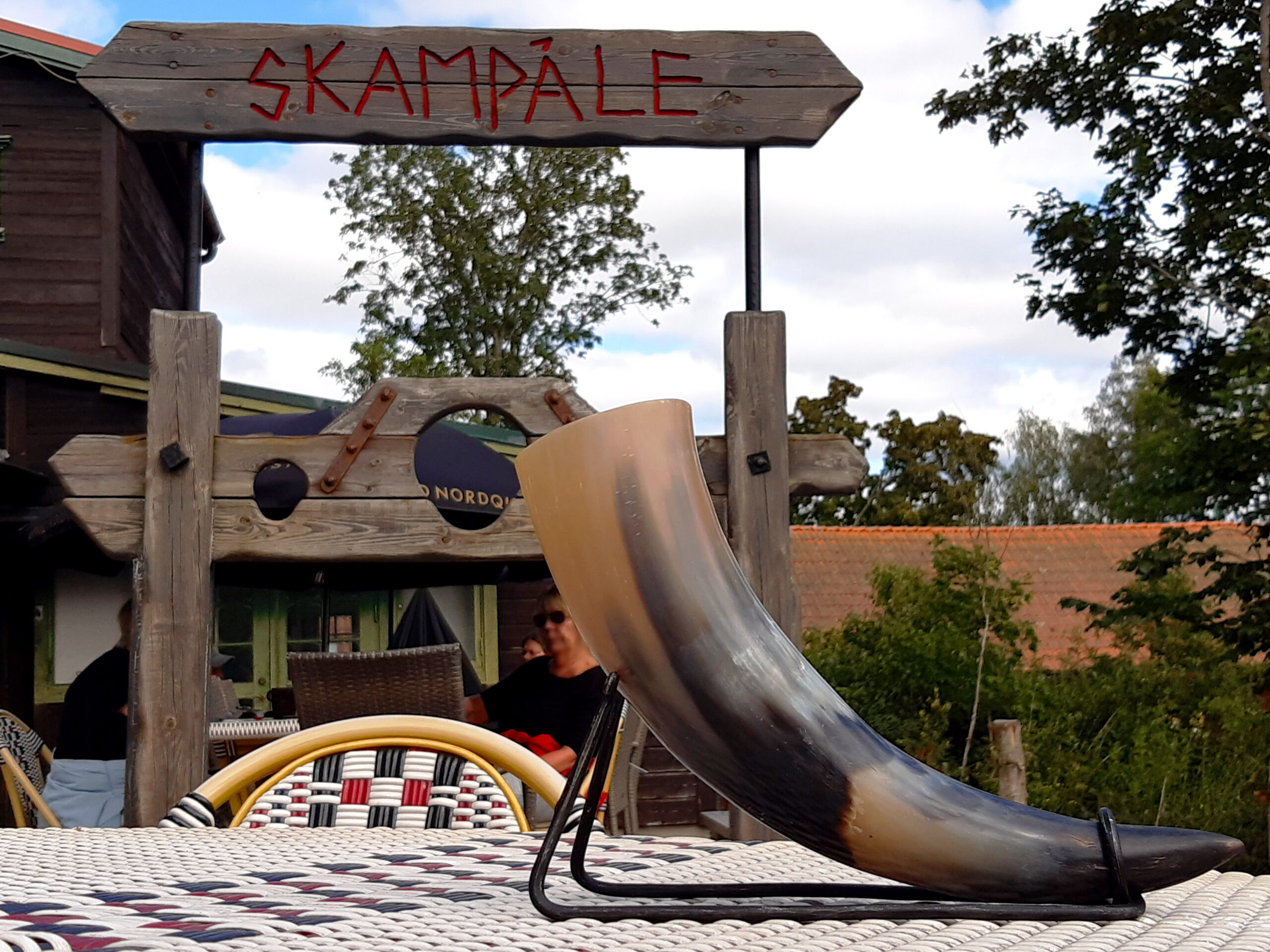
The pillory was a common form of punishment in Medieval and early modern Europe. The Swedes preferred a pole called skampåle, literally a “shame pole”. Though a cruel practice to our modern sensitivities, it had its purpose. In a society without prisons, where few could afford fines, corporal punishment served as an alternative. It was public, conspicuous and, not least, limited: the offender could ideally return to society after the ordeal was over. In addition to this, it also functioned as what French philosopher René Girard calls a “scapegoat mechanism”: the suffering of a single individual had a cathartic effect on society as a whole.
Strictly speaking not a beer, mead, or mjød, is too closely associated with Viking culture to be ignored here. It was often drunk from horns somewhat like this one, though a stand was not required, since the drink was either passed around or emptied in one go.[1] Honey is found in nature, and has a high sugar content. For these reasons, it was perhaps the first alcoholic drink man ever made. It has a strong smell of fermentation, and tastes like a liquor. The honey flavour combines with various fruits and berries.
[1] Neil S. Price, The Children of Ash and Elm: A History of the Vikings (Penguin Books, 2022), 120.
[1] Adam von Bremen, History of the Archbishops of Hamburg-Bremen (Columbia University Press, 1959), 207-8.
[2] Paul Buckland and Eva Panagiotakopulu, ‘Archaeology and Palaeoecology of the Norse Atlantic Islands: A Review.’, in Vikings: The North Atlantic Saga, ed. William W. Fitzhugh and Elisabeth I. Ward (Smithsonian Institution, 2000), 142.
[3] Chris Wickham, The Inheritance of Rome: A History of Europe from 400 to 1000 (Viking, 2009), 480.
[4] Anders Winroth, The Age of the Vikings (Princeton University Press, 2014), 50.
[5] Else Roesdahl, The Vikings, trans. Susan M. Margeson and Kirsten Williams (Penguin Books, 2016), 197–8.
[6] Price, The Children of Ash and Elm, 77.
[7] Jón Viðar Sigurðsson, Viking Friendship: The Social Bond in Iceland and Norway, c. 900-1300 (Cornell University Press, 2017), 18–22.
[8] James C. Scott, Against the Grain: A Deep History of the Earliest States (Yale University Press, 2017), 32–35.
[9] This was less the case in the Far East, where nomads of the steppes clung to their uncouth ways for 2000 years in the face of Chinese civilization: Thomas Jefferson Barfield, The Perilous Frontier: Nomadic Empires and China (B. Blackwell, 1989), 2.
[10] Heather O’Donoghue, Old Norse-Icelandic Literature: A Short Introduction (Blackwell, 2005), 149–201.
[11] Halvdan Koht, Sagalitteraturen: Populære Førelesningar (Det norske samlaget, 1938), 28.
[12] P. B. Taylor and W. H. Auden, trans., The Elder Edda: A Selection (Random House, 1969), 47.
Leave a Reply